
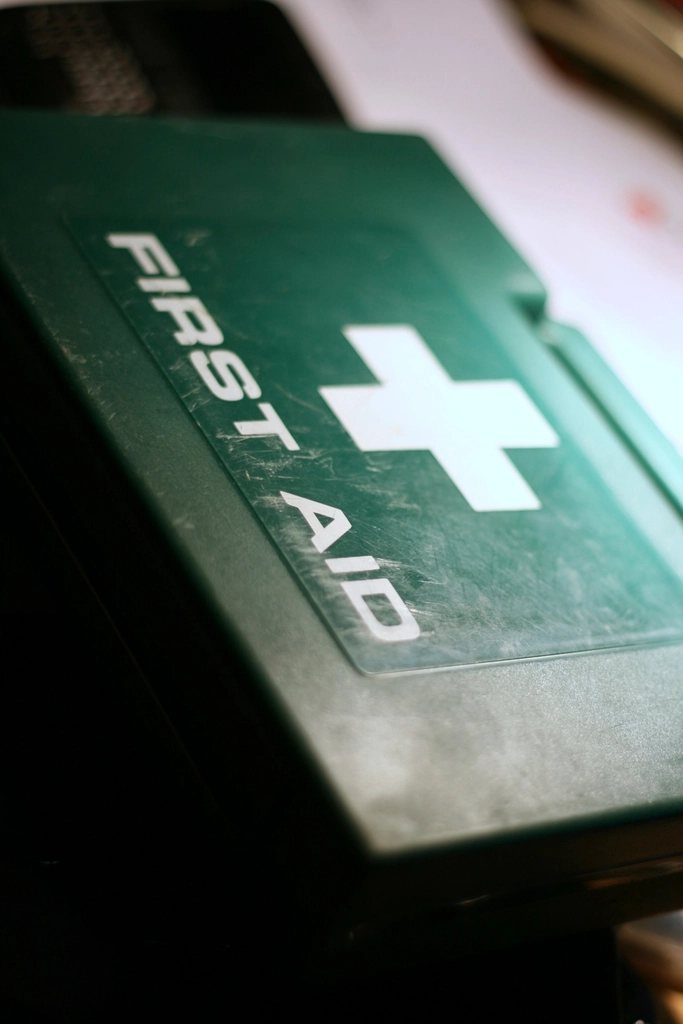
Most of what goes wrong on a youth trip is small: a slice from a knife while whittling, a heel rubbed raw on the second day, an ankle rolled on a root, a shivering paddler after a capsize. A 12-year-old who has practised can handle each of these confidently in the first ten minutes while an adult decides what happens next. This is not a substitute for a proper first aid course (every group should have at least one certified leader), but it is the set of skills we want every young person to own before they carry a pack.
Table of Contents
The habits that come before the bandage
Before touching anyone, we stop and look at the scene. Is whatever caused the injury still a danger: a wobbly canoe, a lit stove, a slope of loose rock? We move the danger or move the person, never treat in the middle of it. Then we talk: “Can you hear me? What happened? Where does it hurt?” A person who answers clearly is breathing and conscious. We sanitise our hands, put on the gloves from the kit, and tell an adult leader immediately, even for a small cut. The rule is simple: the young person treats, the adult knows.
A personal kit for a 12-year-old fits in a sandwich bag: a pair of gloves, six adhesive bandages of mixed sizes, a roll of 2.5-centimetre (1-inch) tape, two sterile gauze pads, a small roll of gauze, a few blister pads, a triangular bandage, tweezers, and a pencil with a scrap of paper to note the time. Everything else lives in the group kit.
Cuts and scrapes: pressure, clean, cover
Almost all bleeding stops with firm, direct pressure. Press a gauze pad straight onto the wound and keep pressing for a full five minutes by a watch, without peeking; peeking pulls off the clot and restarts the clock. If the gauze soaks through, add more on top rather than removing it.
Once the bleeding has stopped, rinse the wound with clean drinking water squirted from a bottle to flush out grit. Do not scrub, and do not pour anything stronger than water into it. Pat the skin dry, apply a bandage or a gauze pad taped on all four sides, and check it twice a day for spreading redness, warmth or pus, which mean infection and a conversation with the leader about getting the person seen.
Any cut that gapes open, sits over a joint, keeps bleeding after ten minutes of pressure, or was made by something dirty like a rusty nail is a job for a leader and probably for a clinic. Animal bites always are.
Blisters: prevention first, then the two-choice rule
A blister starts as a hot spot, and a hot spot treated in the first five minutes never becomes a blister. The moment a heel or toe feels warm or rubbed, we stop, take the boot off, and cover the area with tape or a blister pad. Nobody gets to be embarrassed about stopping the group for this; it takes two minutes and saves two days.
If a blister has already formed, there are two choices. A small one that is not in the way stays intact; we cut a doughnut of moleskin or padding with a hole in the middle so the pad takes the pressure and the blister does not, then tape over the whole thing. A large, tense blister on a spot that must bear weight can be drained by a leader: clean the skin, puncture the edge with a sterilised needle, press the fluid out gently, leave the roof of skin in place and cover it. A 12-year-old learns the padding method and leaves the draining to an adult.
Prevention is mostly boring: boots worn in before the trip, socks changed when wet, laces snugged before descents, and feet aired at every long break.
Sprains and the walk-or-carry question
A rolled ankle on a root is the most common trail injury we see. The immediate treatment is rest, ice, compression and elevation. In the field that means sitting the person down, wrapping the ankle firmly but not tightly with gauze or an elastic bandage in a figure-of-eight, and raising it on a pack. Cold helps in the first hour: a bottle from a stream or a wet cloth held against the joint for 15 minutes at a time, never ice directly on skin.
The question everyone asks is whether the person can walk. If they can put weight on the foot and take four steps, even limping, it is probably a sprain and they can usually walk out slowly with the boot laced tight. If they cannot bear weight at all, if the ankle is bent at an odd angle, or if there is sharp pain when we press on the bony bump on either side, we treat it as a possible fracture: keep the boot on, splint with a rolled sleeping pad and tape, and the leaders decide about evacuation.
- Sit the person down and remove nothing that will not go back on if the joint swells; loosen the boot but leave it on.
- Wrap from the toes upward, snug enough to support but loose enough that the toes stay pink and warm.
- Raise the leg on a pack and keep the person warm; sitting still in a breeze cools a body fast.
- Test weight-bearing only after 20 minutes, and stop at the first sharp pain.
Hypothermia: spotting the umbles
Hypothermia does not need winter. A wet child in a 15-degree (59-Fahrenheit) wind after a swim, or a tired hiker in a cold rain, can slide into it in an afternoon. The early signs are the ones a 12-year-old can catch, and we teach them as the umbles: the person mumbles (speech gets slurred or slow), fumbles (cannot work a zipper or a buckle), stumbles (walks clumsily) and grumbles (goes quiet, irritable or says they are fine when clearly they are not). Shivering is present early and is a good sign; a cold person who has stopped shivering is in serious trouble.
The treatment for mild hypothermia is straightforward: get the person out of the wind, replace wet clothing with dry layers, put a hat on, put them inside a sleeping bag, and give them something warm and sweet to drink if they can swallow normally. Light exercise like walking helps once they are dry. Rubbing the limbs does not help.
Prevention comes down to layers and snacks. A young person who eats every two hours, drinks regularly, keeps dry clothing sealed in a bag, and changes out of wet things the moment the group stops almost never gets cold enough to matter.
Practising until it is boring
None of this works if the first time a young person opens the kit is the day someone is bleeding. We run short drills at every meeting: five minutes on pressure with a gauze pad and a stopwatch, a blister-taping relay, a figure-of-eight wrap on a friend’s ankle, a role-play where someone mumbles and fumbles until the others notice. Repeated often enough, the response becomes automatic, which is exactly what we want when it is real.