
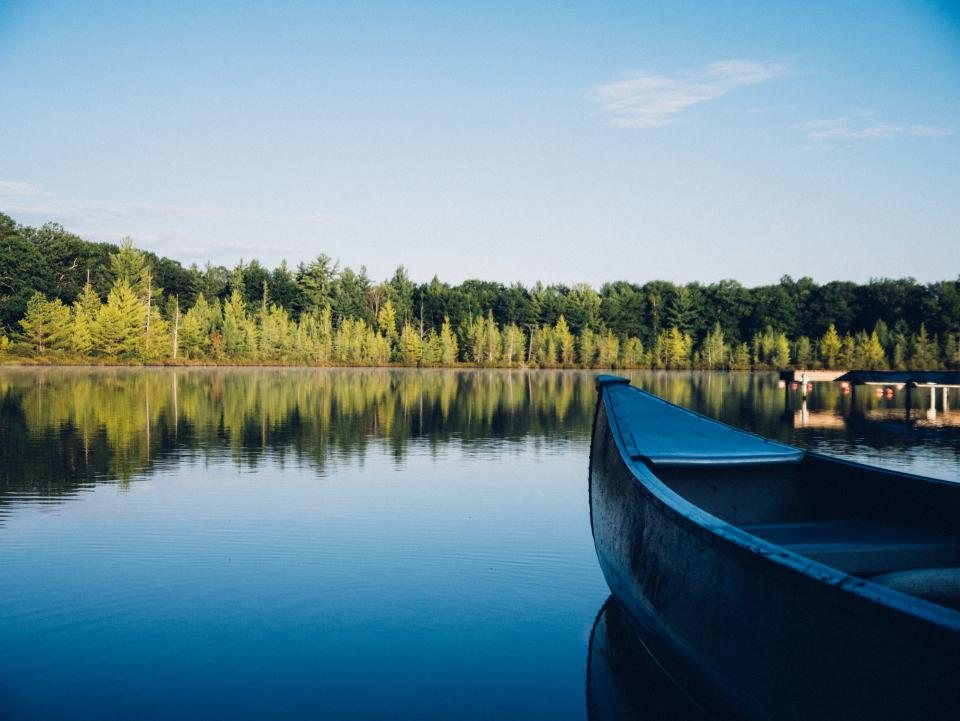
Algonquin is where many Ontario paddlers make their first interior trip, and for good reason. The park covers about 7,600 square kilometres (2,900 square miles) of lakes, rivers and mixed forest between Georgian Bay and the Ottawa River, with more than 2,000 kilometres (1,240 miles) of mapped canoe routes. A group of young people with basic paddling skills can leave the road behind at a marked access point, portage into a quiet lake and camp on a site that is theirs alone. We think a three-day, two-night loop is the right size for a first trip: long enough to feel remote, short enough to recover from mistakes.
Table of Contents
Choosing a route that fits the group
The park has roughly 30 access points. Most first-timers start on the Highway 60 corridor because it is easy to reach from southern Ontario, about three and a half hours by road from Woodstock, and because the lakes there are well used and well marked. Look for a route with two or three short portages, none longer than about 1,000 metres (0.6 miles), and total daily paddling of 8 to 12 kilometres (5 to 7.5 miles). Portage distances are posted on yellow signs at each landing and printed on the official canoe route map, which we treat as essential kit, not an optional extra.
Plan to camp on a lake one or two portages away from the access point. That first carry filters out the day-trippers, but it keeps an evacuation to the road within a couple of hours if a paddler is hurt or sick. Avoid big open lakes on the first trip. Wind builds by mid-morning on large water, and a loaded canoe with two twelve-year-olds in it does not handle a metre of chop well.
Permits, reservations and group size
Interior camping in the park requires a backcountry permit, and the campsite reservation system works by lake, not by individual site: we book a number of sites on a named lake for each night, then choose a free site when we arrive. Reservations open months in advance and popular lakes near the corridor fill quickly for July and August weekends, so we book as soon as dates are fixed. The maximum group size on one site is nine people, which for us usually means six or seven youth and two adults per site. A larger group needs a second site, ideally on the same lake, and we brief everyone that the two sites function as one camp for meals and safety.
Two rules catch new groups out. Cans and glass bottles are banned in the interior, so all food is repacked into bags and plastic containers before we leave. And every person needs a properly fitted personal flotation device, worn, not stowed, whenever the canoe is on the water. We do not negotiate on that.
Timing the season
Ice usually leaves the lakes in the last week of April or the first week of May. Blackflies emerge about two weeks later and are at their worst from mid-May to mid-June; mosquitoes take over into July. For a youth group, we prefer late August or September. The bugs are largely gone, the water is still warm enough for a swim, the days are long enough, and the maple hillsides begin to turn in the last two weeks of September. Nights can drop to 5 C (41 F) in September, so sleeping bags rated to freezing are not excessive.
Packing the canoe
A first interior trip is a lesson in weight. Everything that goes in the canoe has to be carried on someone’s back across every portage, and a 60-litre pack plus a 25-kilogram (55-pound) canoe is a serious load for a sixteen-year-old. We aim for one pack per two paddlers, plus a food barrel per four to six people, and we do a full pack-out the week before so that nobody discovers a missing tent pole on the beach.
- Shelter: three-season tents with full flies, a tarp with 20 metres (65 feet) of cord, and a groundsheet.
- Kitchen: two stoves with fuel for all meals, a pot set, a water filter and a backup of purification tablets, plus 30 metres (100 feet) of rope and a carabiner for the food hang.
- Safety: a group first-aid kit, a bailer and a throw bag in every canoe, a spare paddle per canoe, a whistle on every flotation device, and a map in a waterproof case.
- Personal: one dry set of camp clothes in a dry bag, a warm hat, rain gear, closed-toe water shoes, and a headlamp.
Bears, food and camp routine
Algonquin has a healthy black bear population and a much larger population of raccoons, mice and chipmunks. All of them are after food, not people. Every evening, before dark, all food, garbage, toothpaste and anything scented goes into the barrel or bag and is hung at least 4 metres (13 feet) off the ground and 2 metres (6.5 feet) from the trunk, or stored a good distance from the tents where a hang is impossible. Cooking happens at the fire ring, never in a tent. We wash dishes well back from the shoreline and scatter grey water away from camp.
Moose are the animal most groups actually see, usually at dawn feeding in a bay. They are wonderful and they are big; we watch from the canoe and keep our distance. Loons will call every night. A camp routine that puts youth in charge of a task each – water, fire, kitchen, hang – gives the trip its shape and gives leaders time to check feet, sunburn and morale.
Water, weather and the decision to stay put
All drinking water is filtered or boiled; the lakes look clean but giardia is present across the park. We paddle early, when the water is calm, and aim to be on the campsite by early afternoon. If thunder is heard, everyone is off the water and away from tall isolated trees until 30 minutes after the last rumble. If the wind is up and the next leg crosses open water, we wait, sometimes for hours. A leader who is willing to sit on a rock and drink tea while a gale blows is teaching the most important skill of the trip.
The reward for all this care is a group that comes out of the woods a little muddy, a little tired and quietly proud. They carried their own gear, they navigated by map, they slept where nothing but a loon disturbed them. For many young people it is the first time they have been truly away from a road, and it tends to stay with them.