
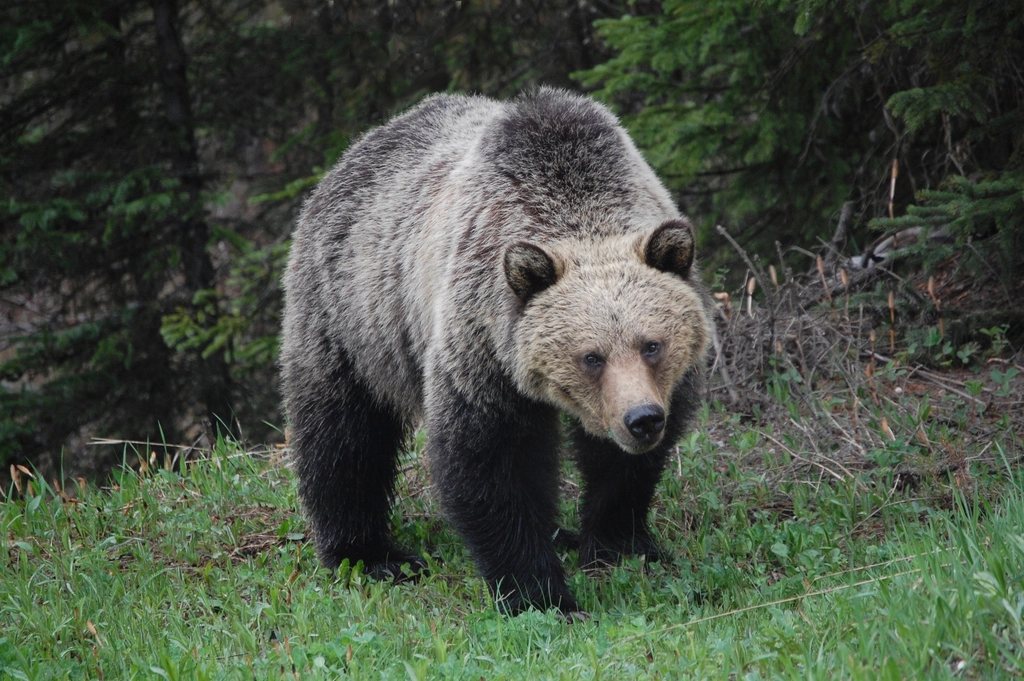
Sharing the woods with animals is one of the great pleasures of being outside, and most encounters in Ontario are harmless. The few that go wrong almost always start with food: a granola bar in a tent pocket, a greasy pan by the fire, a barrel on the ground because the group was tired. This guide covers the three animals young people ask about most (black bears, ticks and moose) and the one habit that prevents nearly all the trouble: a food hang done properly every night.
Table of Contents
Black bears: what they actually want
Ontario has an estimated 85,000 to 105,000 black bears and no grizzlies, and the vast majority live their whole lives without confronting a person. A black bear is a large, shy omnivore that spends its waking hours eating berries, grubs, grass and, when the opportunity arises, our food. Its interest in a campsite is entirely about calories, and a bear that has learned campsites mean easy calories becomes a problem.
On the trail, we make noise where sightlines are short, talking and clapping at blind corners and near loud water, so no bear is surprised. If we see a bear at a distance, we stop, gather the group, and give it space to leave. If it has cubs, we back away the way we came. If a bear approaches, we do not run; we stand together, make ourselves tall and loud, wave arms, and back away slowly while facing it. A bear on its hind legs is looking and sniffing, not charging. In the extremely rare event of a black bear making contact, fight back with everything available; this is the opposite of the advice for grizzlies elsewhere in Canada.
Bear spray belongs on a leader’s hip, not in a pack, and every adult carrying it should have practised with an inert canister. A whistle and a group of voices are the tools every young person has.
Ticks: the small one that matters most
Statistically, the animal most likely to harm a young person in Ontario is a tick the size of a sesame seed. Blacklegged ticks, which can carry the bacteria that cause Lyme disease, have spread across southern and central Ontario over the past two decades. They wait on grass and low brush from early spring until the first hard frosts, with peaks in May and June and again in the fall.
Prevention is layered. We wear long pants tucked into socks in grassy areas, treat outer clothing with permethrin before the trip if allowed, apply a proven repellent on exposed skin, and stay in the middle of trails. The most effective habit is the daily tick check: at the end of every day, each person checks their own skin from the feet up, with a buddy for the back of the neck, the hairline and behind the ears. Ticks favour warm, hidden places such as the groin, armpits, waistband and the backs of the knees.
An attached tick is removed with fine-pointed tweezers: grip it as close to the skin as possible, pull straight up with steady pressure, and do not twist, burn or smother it. Clean the bite and note the date. A tick attached for less than 24 hours is very unlikely to transmit disease, which is why the daily check works. If a spreading red rash, fever, fatigue or aching joints appear in the following weeks, the person needs to see a doctor and mention the tick.
Moose: bigger than the car and less predictable than the bear
Moose are the largest animals in Ontario, with bulls standing 1.8 to 2.1 metres (6 to 7 feet) at the shoulder and weighing up to 600 kilograms (1,300 pounds). They are most often seen at dawn and dusk feeding in shallow water and along roads. Moose do not care about our food, but they injure more people in Canada each year than bears do, mostly because people assume a plant-eater is safe to approach.
The two dangerous seasons are late spring, when cows with newborn calves defend them fiercely, and the fall rut in late September and October, when bulls are aggressive and unpredictable. The signs of an irritated moose are clear: ears laid back, hair standing up along the neck and shoulders, lip licking, and a lowered head. If we see any of these, we leave the way we came, and if a moose charges we do not stand our ground; we run and put a tree, a boulder or a canoe between us and it.
On the water, we give a swimming moose a wide berth and never paddle between a cow and a calf.
The food hang, done properly
A food hang has one job: to put everything with a smell where a bear, a raccoon or a mouse cannot reach it. Done well, it takes 15 minutes and a bit of rope-throwing practice.
- Choose the site before dark, at least 70 metres (about 100 paces) downwind from the tents and away from the kitchen.
- Find a live branch or a span between two trees that lets the bag hang at least 4 metres (13 feet) off the ground, 2 metres from the trunk, and 1.5 metres below the branch.
- Tie a small stuff sack with a rock to the end of 15 to 20 metres of cord, throw it over the branch, then replace the rock with the food bag and haul it up; for a heavy barrel, use a two-tree span with a hauling loop.
- Everything scented goes up: food, garbage, toothpaste, sunscreen, lip balm, the pot and the dishcloth.
- Tie the tail of the cord off on a different tree, out of reach, and check the hang from a distance before bed.
Where trees are too small or too sparse for a proper hang, many parks provide steel food lockers at designated sites, and bear-resistant barrels stored 70 metres from camp on the ground are an accepted alternative. A barrel is bear-resistant, not bear-proof; close it properly and place it away from cliffs and water so an animal cannot roll it somewhere unrecoverable.
The clean-camp routine
The food hang is the last step of a routine that starts with cooking. We cook and eat in one spot, 70 metres from where we sleep. We eat everything we cook, or pack out leftovers in a sealed bag rather than burying them. Dishwater is strained through a bandana, the solids go in the garbage, and the water is scattered on soil well away from camp. Nobody eats in a tent, ever, and the clothes we cooked in do not come into the tent either.
We also respect the small animals. Chipmunks and mice chew through packs and tent walls for a single crumb, and raccoons open zippers, so a “just for tonight” bag under the vestibule is an invitation. Every young person checks their own pockets and pack before the hang goes up, and the last person to bed walks around the site with a headlamp. That walk, done every night without exception, is most of what wildlife sense really is.